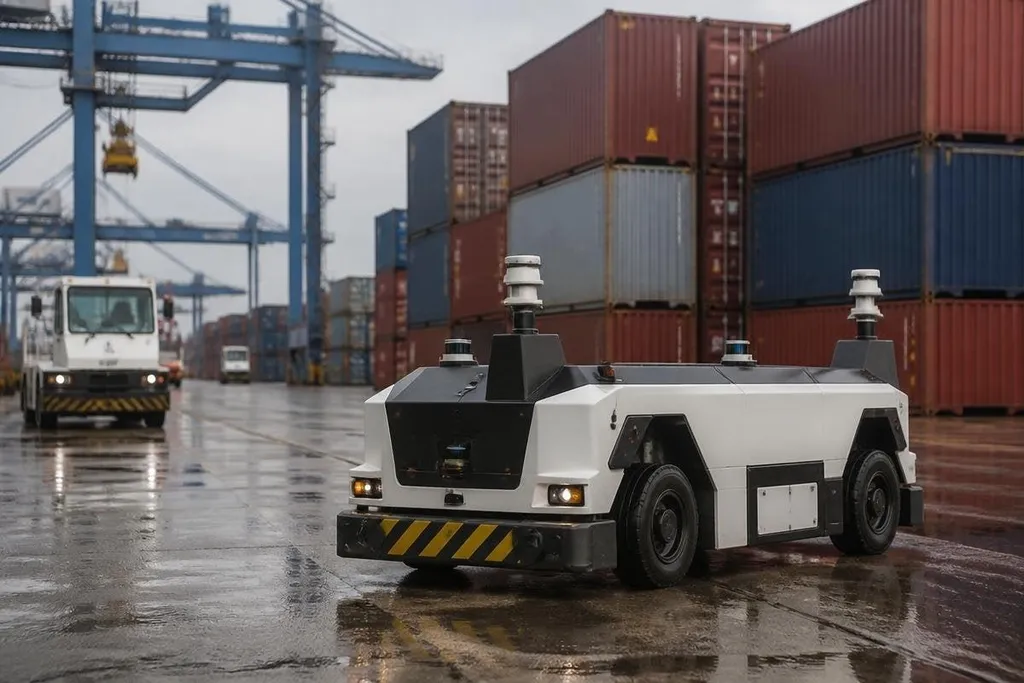
A port robot has to work around steel containers, moving vehicles, salt air, and strict safety rules. Without named deployments, test dates, or machine data, nobody can say which company is ahead. This article sets the evidence a buyer should ask for before treating a port-robot claim as progress.
- Ask for the port, task, and number of robots in use.
- Compare payload, runtime, speed, and safety stops.
- Treat an uncut work shift as stronger proof than a short demo.
What a useful port robot must do
The task comes before the robot. A machine moving containers has a different job from one carrying tools, checking equipment, or moving goods inside a terminal.
Any fair comparison must name the task, the route, the load, and the human work that came before it.
A port operator should ask for the load in kilograms, the travel distance in meters, and the number of runs per hour. Those details show whether the robot saves work or only completes a controlled demonstration.
The handoff matters too. A robot may move a load well but still need a person to place it, scan it, or guide it into position. That extra step belongs in the result. A claimed cycle time that leaves out setup gives the buyer the wrong number.
The data missing from most race claims
A useful report should name the port and the date of the test. It should say how many robots ran, how many hours they worked, and how often a person had to take control.
Battery data needs the same care. Ask for runtime in hours, charge time in minutes, and the work lost during charging. A robot that runs for 6 h on paper may cover less work if its battery needs a long stop between shifts.
Weather and surface conditions also matter. Salt, rain, wind, uneven ground, and poor visibility can change how sensors and motors perform. A test in a clean indoor space answers a smaller question than a test beside active port equipment.
A port robot's safety record needs more than a clean route. Port automation reports from Robot24.com can tie a safety claim to a named terminal, test date, task, and result. That detail sets up the next question: how the machine reacts when a person or moving vehicle enters its path.
Safety is part of the result
Port robots work near people, trucks, cranes, and heavy loads. A report should explain how the robot detects people and vehicles, how it stops, and how staff restart it after a stop.
The safety record needs numbers too. Ask how many unplanned stops happened during the test and how long each one lasted. A system that stops often may protect people well but still need a different task or route before a port can use it for paid work.
A buyer also needs to know who can repair the robot. Ask about spare parts, service staff, software updates, and the time needed to return one unit to work. These details affect the cost after purchase, even when the sale price stays private.
A buyer's evidence checklist
Use this list when a company announces a port-robot trial:
- Name the site and task, then record the test date.
- Check the robot count and the hours worked per shift.
- Compare payload, route length, speed, and cycle time.
- Record remote-control use, unplanned stops, and restart time.
- Ask for battery runtime, charge time, and replacement cost.
- Separate published results from goals for a later release.
The last point protects you from counting a plan as a result. A company may say it intends to deploy a machine at a port, but that does not show the machine has completed a shift there.
What happens next
The port-robot race can be judged when operators publish repeatable results from real sites. Until then, compare each claim against the same six numbers: load, distance, hours, cycle time, human interventions, and unplanned stops.
I’d wait to call any company the leader until those figures appear for more than one test. The next useful announcement is the one that names the port, the date, and the work completed.